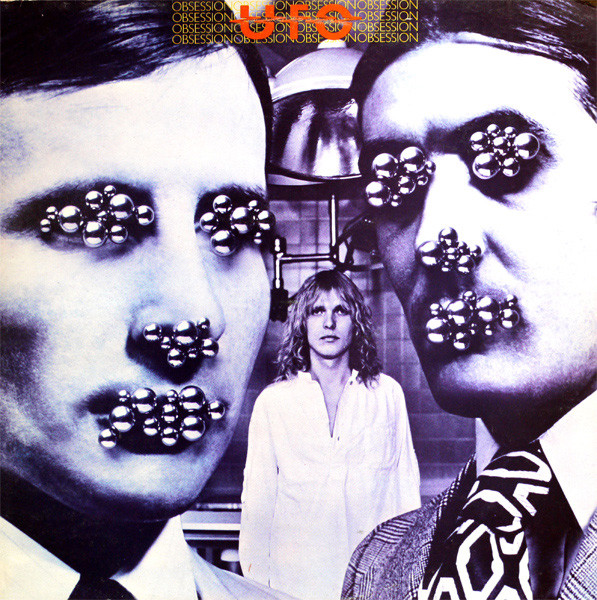
Released in 1978, Obsession stands as the seventh studio album by English rock band UFO and holds a significant place in the group's rich history. Most notably, this record marked the final studio release to feature virtuoso lead guitarist Michael Schenker until his eventual return to the fold in 1993. The core lineup for the sessions consisted of vocalist Phil Mogg, lead guitarist Michael Schenker, keyboardist and rhythm guitarist Paul Raymond, bassist Pete Way, and drummer Andy Parker. Behind the mixing board, the band worked with producer Ron Nevison, while the recording sessions themselves took on a distinct atmosphere, having been conducted inside an abandoned post office located in Los Angeles. The striking visual presentation of the album was handled by the renowned design firm Hipgnosis, which provided the striking cover art, while Alan McMillan contributed arrangements and conducted strings for the project.
The promotional campaign surrounding the album yielded additional material for fans. A single featuring "Only You Can Rock Me" backed with "Cherry" was released in 1978. Furthermore, the band issued their first three-track EP, which featured "Only You Can Rock Me" and "Cherry" alongside "Rock Bottom," successfully climbing to number 50 on the UK singles chart. Over the years, Obsession has continued to receive expanded reissues. EMI's 2008 remastered edition arrived with three bonus live tracks and corrected writing credits. Decades later, in 2024, Chrysalis issued a comprehensive deluxe edition across two compact discs and three vinyl LPs. This modern package presented a fresh remaster alongside an entire live performance from Cleveland, which was newly remixed specifically for the 2024 release.
Upon its release, Obsession drew a range of critical evaluations from contemporary and retrospective commentators. Reviewing the LP in Christgau's Record Guide: Rock Albums of the Seventies in 1981, critic Robert Christgau expressed mixed sentiments, noting that he had previously admired their forward motion and facile riffs, but felt obligated to report that they had degenerated into usual exhibitionism, pointing to tracks like "Lookin' Out for No. 1" as emblematic of late-1970s rock lyrical trends. AllMusic reviewer Greg Prato observed that the record indeed contained plenty of prime metal cuts, though he felt some of the material ultimately fell flat. Meanwhile, Canadian journalist Martin Popoff characterized the album as an aseptically professional, melancholy, yet finely crafted and memorable display of keyboard-powered metal, while concurrently critiquing Ron Nevison's brash and boomy live-feel production and noting a near-total absence of the band's more connecting, warm hard rock elements.
In terms of its commercial performance on the United States charts, UFO found steady traction with the release. Entered into the Billboard 200 albums chart, Obsession made its initial appearance on the week of July 29, 1978, opening at rank 148. The album steadily climbed upward over the subsequent weeks as word of mouth and airplay took effect, breaking into the upper tiers of the chart. By the week of September 23, 1978, the record achieved its peak position, landing at rank 41, a spot it successfully defended the following week. Altogether, Obsession maintained a continuous presence on the Billboard 200 for a total of 18 weeks before completing its chart run in late November of 1978.
Last Updated: 2026-07-26